Behavior & Training
How to Stop a Cat From Biting and Rough Play
Learn why cats bite during play and how to redirect that energy so your hands stay scratch-free. Practical steps for kittens and adult cats.
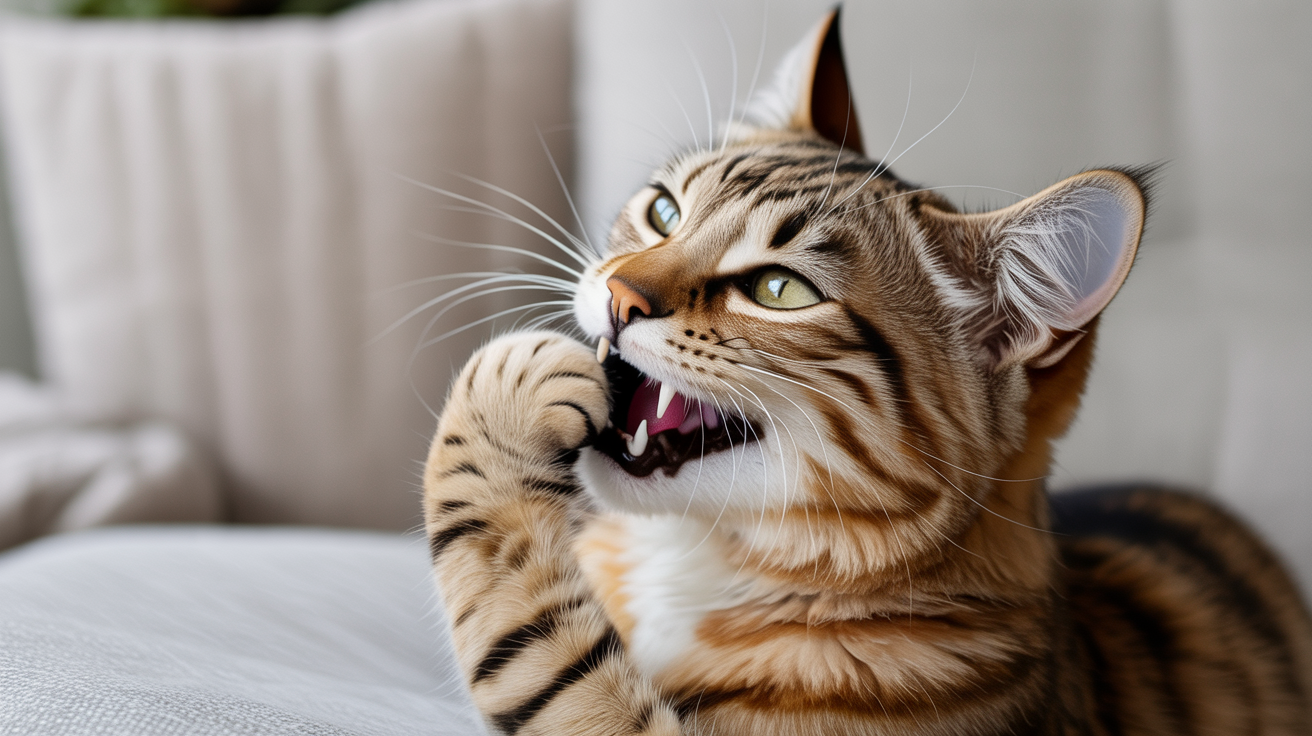
Cats bite during play because it's a completely normal part of how they hunt and roughhouse. The problem isn't the biting instinct itself, it's when your hands become the prey. The good news is that with consistent redirection, most cats learn pretty quickly that skin is off-limits.
Why cats bite and play rough
Biting and wrestling are how cats rehearse hunting. They stalk, pounce, grab, and bite, and they do it with or without a live target. Young cats especially need this outlet. A kitten that bites hands isn't being aggressive; it's doing exactly what evolution shaped it to do.
That said, there are a few distinct situations:
- Play biting, low-pressure nips, often during a chase or pounce. The cat is excited, not angry.
- Overstimulation biting, happens mid-petting when a cat suddenly whips around and bites. There's usually a visible warning: tail lashing, skin rippling, ears going flat.
- Fear or pain biting, the cat bites because it's cornered, hurt, or startled. This warrants a vet visit if there's no obvious trigger, since pain is often behind sudden behavior changes.
- Learned hand-play, common when kittens were encouraged to chase and bite fingers as babies. The behavior gets bigger as the cat gets bigger.
Knowing which type you're dealing with shapes how you respond. Overstimulation biting, for instance, is solved mostly by reading the cat's body language and stopping petting earlier, not by toy redirection.
The core rule: never use your hands as toys
If there is one thing to take away, it's this. Hands that wave, wiggle, or dart around look exactly like prey to a cat. Even if you mean it as play, the cat is practicing biting a hand-shaped thing. Over time, that habit becomes second nature.
Stop all hand-play immediately. If someone else in the house does it (kids are the usual culprits), everyone has to get on the same page. An inconsistent rule teaches the cat that biting sometimes works, which is the worst possible lesson.
How to redirect cat biting
Redirection is the practical solution for most cases of cat aggressive play. The idea is simple: when the cat wants to bite, give it something appropriate to bite.
Wand toys are the gold standard. A feather wand or ribbon toy lets you mimic prey movement from a safe distance. Drag it along the floor, make it dart behind furniture, let the cat actually catch and bite it. A good play session, 10 to 15 minutes, twice a day, takes a lot of steam out of an overzealous cat.
Plush kicker toys (the long stuffed ones cats can bunny-kick) give a cat a target for the full grab-and-bite-and-kick sequence. These are especially useful for cats that like to ambush legs or feet.
When a cat bites you during play, the response is not punishment, it's a clean, immediate stop. Stand up, fold your arms, turn away. No yelling, no flicking the nose, no pushing the cat away (that just becomes part of the game). Cats read disengagement clearly. The play stops when biting happens.
If the cat chases your feet as you walk away, step around a corner and close a door for 30 seconds. A brief time-out signals that biting ends the fun. Be consistent: every single time, the same response.
Just as redirection works for biting, the same principle applies when a cat targets furniture, if you're working on that problem too, the approach in why cats scratch and how to redirect it to a post follows the same logic.
Helping kittens learn bite inhibition
Kittens learn a lot about bite pressure from their littermates. A kitten that was weaned too early or separated too soon often bites harder than normal because it missed that feedback. You can teach it the same lesson.
When a kitten bites hard, make a short sharp sound (a quick "ow" or "ah") and immediately go still. Don't pull your hand back fast, that triggers the prey-chasing reflex and makes things worse. Go limp. The game stops.
Then redirect to a toy. The goal isn't to stop the kitten playing; it's to move the play onto something appropriate. Kittens have short attention spans, so pivoting quickly to a wand toy usually works.
A tired kitten bites less. Schedule two or three structured play sessions a day, morning and evening especially, since cats are naturally more active at dawn and dusk. This also helps with nighttime energy surges. If your cat is keeping you up, it's worth reading why your cat meows at night and how to get sleep for context on that pattern.
Signs the biting warrants a vet visit
Most play biting is a training issue, not a medical one. But see a vet if:
- The biting started suddenly in an adult cat with no change in routine
- Your cat hisses, growls, or seems genuinely frightened during what should be normal interaction
- The cat bites and then immediately seems confused or disoriented
- Wounds from bites are deep, or you see signs of infection (redness, swelling, pus)
Pain can make even the calmest cat lash out. Dental disease, arthritis, or an internal issue can all cause a cat to bite when touched in certain spots. If the behavior came out of nowhere, rule out a physical cause first.
Frequently asked questions
How long does it take to stop a cat from biting?
It depends on how ingrained the habit is. A kitten that's only been biting hands for a few weeks can often redirect within a couple of weeks of consistent training. An adult cat that has bitten hands its whole life may take a few months. The key word is consistent, if the rule changes, progress resets.
My cat bites me when I pet it, not during play. What's going on?
This is almost always overstimulation. Cats have a tolerance threshold for petting, and when it's crossed, they bite. Watch for early signals: tail flicking, skin twitching along the back, ears angling back. Stop petting before those signs escalate. Some cats only tolerate a minute or two of contact; learn your cat's limit and respect it.
Should I scruff my cat to stop biting?
No. Scruffing (grabbing the loose skin at the back of the neck) is stressful for adult cats and is no longer recommended by most veterinary behaviorists. It doesn't teach the cat anything useful and can damage your relationship. Disengagement and redirection are more effective and far less aversive.
Is it okay to play rough with my cat if it seems to enjoy it?
In the moment, yes, but if rough play involves your hands as the target, the cat is learning a habit that will cause problems later. What feels playful to a kitten becomes painful with an adult cat's full jaw strength. Set the boundary now, even if the cat seems fine with hand-play.
My kitten bites my ankles when I walk. What should I do?
Keep a small toy in your pocket for exactly this situation. The moment the cat starts stalking your feet, toss the toy ahead of you. This gives the cat a legitimate target for that ambush impulse. Over time, you can combine this with structured play sessions so the cat isn't as wound up when you're moving around the house. It also helps to understand litter box and territory habits since stress from environmental changes can spike play aggression in some cats.
This article is general guidance for cat owners, not a substitute for advice from a licensed veterinarian who can examine your cat.